

Q2
Market update
July 2026
Veterinary Practice
Market Pulse

exclusively from Ackerman Group
Q2
July 2026
Letter to Our
Readers



Ackerman Group is proud to bring you this latest edition of our quarterly research report. Backed by our extensive practice sales dataset and our team’s decades of experience advising on transactions, this report is intended to provide veterinary practice owners, as well as the broader profession, with insights and analyses found nowhere else in the industry.
While not a detailed guide to selling your hospital, this report highlights real-time trends we are observing in the market to help position you and our clients for the best outcomes possible during a sale process.
Should you find yourself thinking about selling your practice and wish to take advantage of our unmatched market experience and extensive dataset, Ackerman Group is ready to assist you from beginning to end. Hundreds of veterinarians have entrusted us with advising them on the sales of their practices, and during the increasingly important time post-sale, when incremental value is frequently earned in transactions today. Our goal is to align with your personal, professional, and financial goals.
We wish you and your practice continued success. Don’t hesitate to reach out with your questions!

Rich Lester
Ackerman Group

Gary Ackerman
Ackerman Group
A Tale of Two Markets Emerges

Strong Economy, Sticky Inflation

The Visit Recovery Question
weak consumer sentiment, which is cyclical, and a new report that describes potentially lower than historical rate of puppy adoptions.

The Average Is Misleading
That number is being pulled upward by a concentrated segment of large, highly profitable practices. For
everyone else, multiples have actually been flat for two-plus years.

Cash at Close Remains Strong

GP Has Overtaken Specialty
Our View

Growth Without Relief
The U.S. economy is sending mixed signals, with an interest rate cut looking increasingly unlikely.
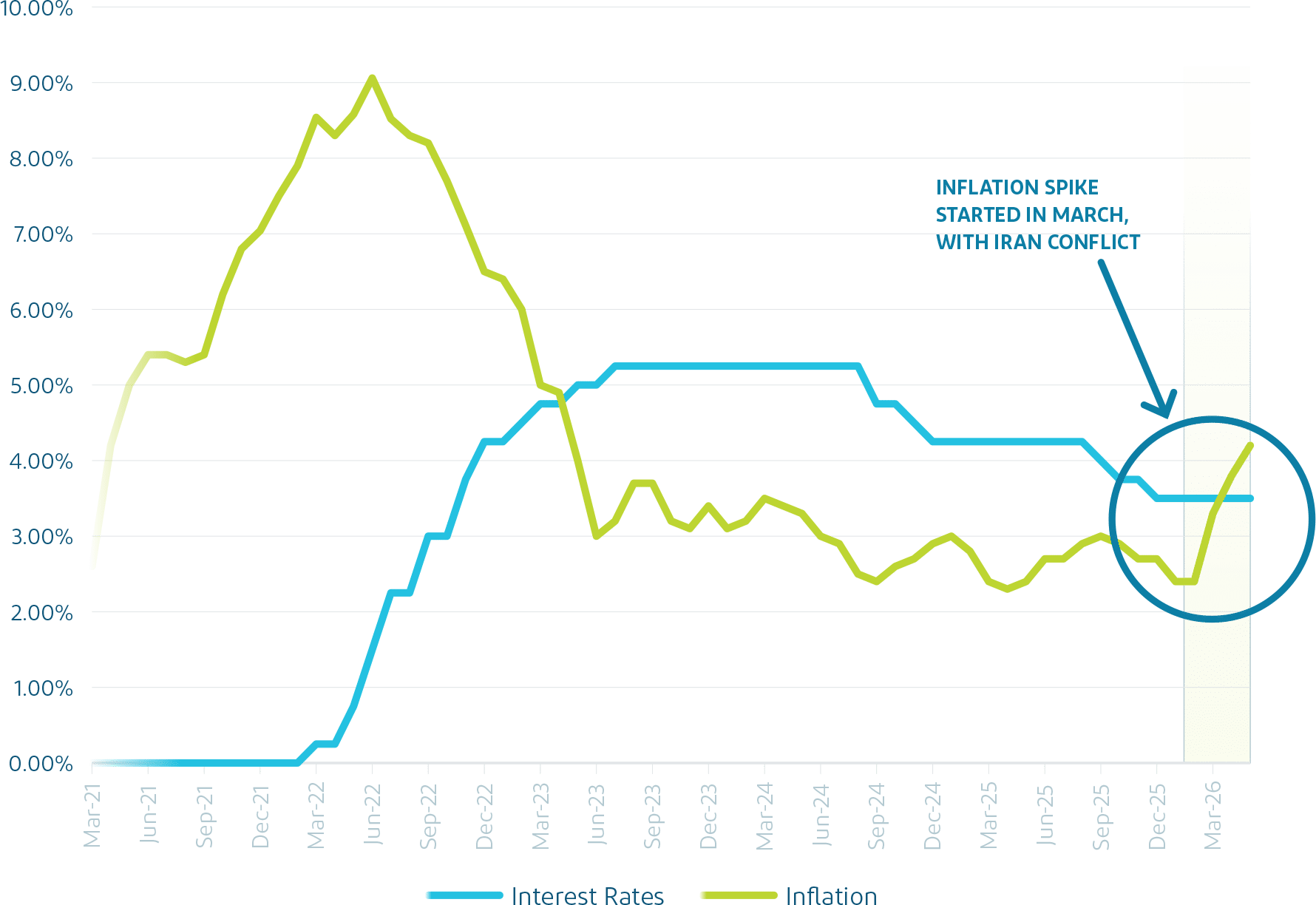
The U.S. economy has outperformed on paper during 2026, but consumer sentiment tells a different story. Q2 GDP growth is forecasted to be a healthy 2.6% and job creation in March, to June has been surprisingly strong. However, when the U.S. and Israel launched an attack on Iran in late February, supplies of oil, fertilizer, and other important commodities were disrupted. The effects have been sharpest in Asia, with U.S. inflation accelerating materially as well.
Interest Rates & Inflation
Rates Stay Complicated
The economy is strong enough to keep inflation pressure alive, but unsettled enough to make relief uncertain. For buyers, that means capital is unlikely to get meaningfully cheaper in the near term.

The Recovery Assumption is Changing
Industry headwinds have a new variable: puppy adoptions have been declining.
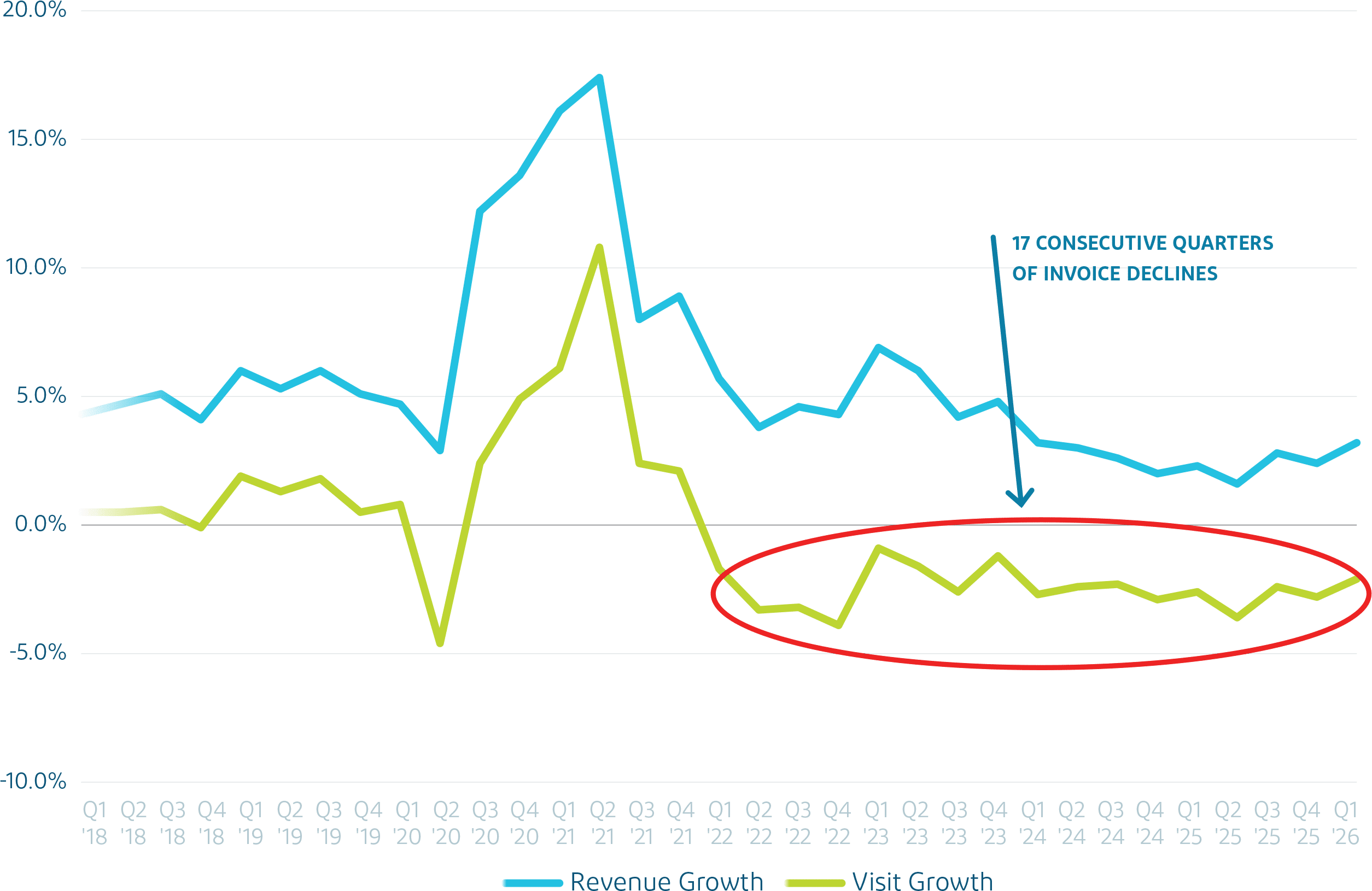
Veterinary invoice volume has now declined for four and one-quarter years, contracting 2–3% annually, an unprecedented multi-year run in an industry with no prior history of sustained decline. The prevailing explanation has centered on higher prices suppressing visit frequency, compounded by weak consumer confidence.
Veterinary Industry Growth-COVID Impact
A June 2026 study from the
CATalyst Council adds a new concern.
Co-authored by former IDEXX CEO John Ayers, it documents a decline in puppy adoption rates from 2022 through 2026 relative to pre-COVID baselines. Cat adoptions have grown over the same period, but cats generate fewer visits per animal than dogs.
Many in the profession have been counting on the COVID-era adoption cohort — the wave of pandemic pets soon to be entering their senior years — to drive a visit recovery in 2027/2028. That recovery may still come. But the CATalyst study suggests the demographic pipeline behind it is thinner than assumed, which means the recovery may be shorter and shallower than investors and buyers have been modeling.

A June 2026 study from the
CATalyst Council adds a new concern.
Co-authored by former IDEXX CEO John Ayers, it documents a decline in puppy adoption rates from 2022 through 2026 relative to pre-COVID baselines. Cat adoptions have grown over the same period, but cats generate fewer visits per animal than dogs.
Many in the profession have been counting on the COVID-era adoption cohort — the wave of pandemic pets soon to be entering their senior years — to drive a visit recovery in 2027/2028. That recovery may still come. But the CATalyst study suggests the demographic pipeline behind it is thinner than assumed, which means the recovery may be shorter and shallower than investors and buyers have been modeling.
What may be flying under the radar for many practice owners is the broad underperformance of the industry’s public bellwethers.
Zoetis reported disappointing Q1 earnings and its share price has fallen roughly 25% as investors question its growth trajectory. IDEXX is down approximately 15% year-to-date. Elanco is slightly positive on the year but trailing the broader market.
None of these declines are directly caused by the visits slowdown, but they signal that institutional investors are taking a harder look at the industry’s fundamentals, and that can matter for how the investors behind the corporate groups behave moving forward.
Buyer Appetite
Watch
We are in active conversations across the industry to understand whether the CATalyst findings are affecting buyer appetite, and to what degree.
We will share what we learn as the picture becomes clearer.


The Call from the Cafeteria:
Dr. Jim Carlson’s Road to the Right Exit
Lifetime Pet Wellness · Columbus, Ohio
Dr. Jim Carlson started Lifetime Pet Wellness to build something special and as he started pondering his next chapter, it became time to evaluate his options.
Backed by extensive research and data exclusively from Ackerman Group

Over the course of his career, Jim and his wife Laurie, the Finance and Marketing Manager, built Lifetime Pet Wellness into a three-doctor small animal practice in Columbus, Ohio, with $2.7 million in annual revenue.
When the time came to think about an exit, they approached it the way most practice owners do: carefully, and with some anxiety about getting it wrong. The Carlsons initially engaged a brokerage firm to start the process. The process seemed off as the discussions kept circling back to one corporate buyer without considering all the options.
They suspected, correctly, that a referral incentive was driving the broker to one buyer rather than what was actually best for them. They stopped the process.
STARTING OVER — DIFFERENTLY.
The initial conversations with the Ackerman Group were not about price. The discussions focused on what did Jim and Laurie wanted the next chapter to look like, how much risk did they want to take, how long did they want to work and their goals for the associates and others. That foundation mattered because what came next was some tough love.
THE MOMENT IN THE CAFETERIA.
The initial profitability analysis was presented to Jim by Dr Roger Redman, a partner at the Ackerman Group, in-person at a cafeteria table at the Midwest Veterinary Conference in early 2025. The analysis showed EBITDA that was below what it should be for a practice of this size and the areas which could be improved. Roger presented what the current sale price would be versus what a correction to the staffing cost structure would mean for the potential sale price.
Sitting in a conference cafeteria, running the math, realizing that twelve months of focused work could fundamentally change the outcome didn’t fit neatly into their desired transaction timeline. Jim called Laurie and discussed what they needed to do. The Carlson’s decided they needed to do the hard work
A YEAR OF REAL WORK.
Over the next twelve months, Jim and Laurie addressed the staffing cost structure while continuing to run the practice. It was the kind of operational discipline that takes diligence while keeping the team and culture intact.
When the financials reflected that work, the practice went to market.
Eight buyer groups expressed serious interest. Offers ranged from 11x to 13x EBITDA — a spread that reflected genuine competition.
The Carlsons chose Mission Pet Health. The partnership structure they landed suited what they’d been looking for: a buyer who understood what they’d built and a deal that reflected it.
We started with another broker, and something just didn’t feel right. Then I heard about Ackerman.
The experience was totally different from the first second of contact. Ackerman started with data; they walked me through an adjusted EBITDA. That told me what I needed to improve, to get the value we wanted. I was told not to go to market until we saw improvement on some of those measures, or if something changed with the market.
This advice turned out to be very sage, as it worked out perfectly. Roger was very helpful when the going got a little rough, and really did a great job.
— Dr. Jim Carlson
If you want more information about this transaction or to talk to the Seller mentioned here as a reference, reach out to Rich Lester at rlester@ackerman-group.com.

The Market is No Longer Moving as One
The weighted average GP valuation multiple for H1 2026 was 13.4x EBITDA, up from 12.4x in H2 2025. It would be a mistake to infer the market is universally healthy from that metric in isolation. The average is being pulled upward by a small subset of practices, and for most readers, it overstates what their practice would actually be valued at.
Average Multiple Trend: Half Yearly
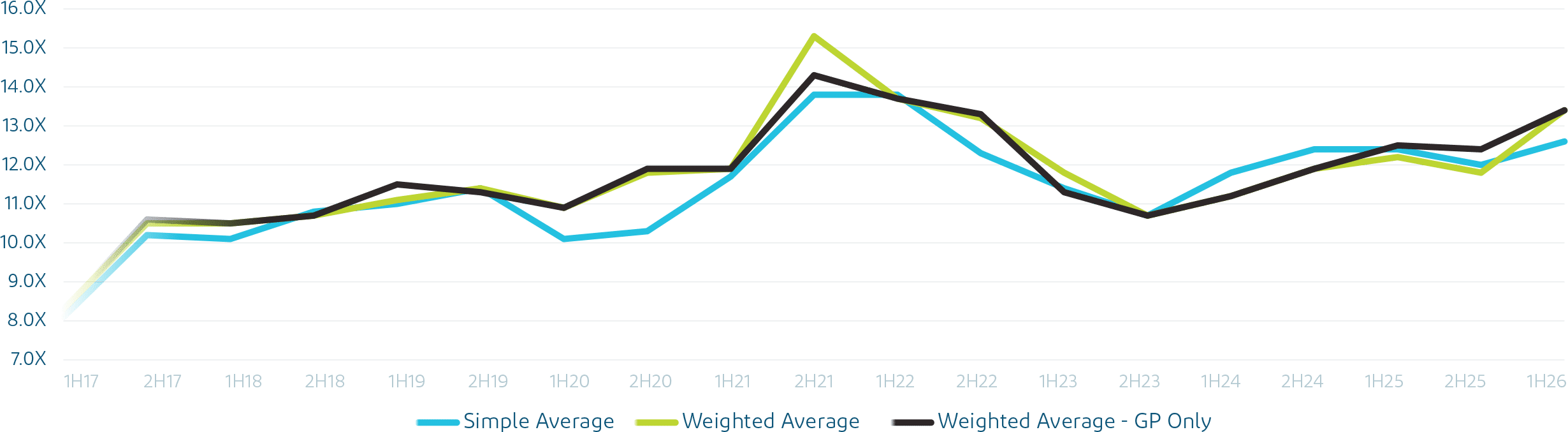
This chart shows the divergence more clearly than any summary can. Large, highly profitable practices, those with scale, strong EBITDA, stable DVM teams, and a building that can absorb more growth, have seen real multiple expansion over the past twelve months. Everything else has been essentially flat for two-plus years. These are two different markets, and conflating them is a mistake for a practice owner.
Weighted Average EBITDA Multiples – GP Practices (Half Year) 5+ DVM Practices (>$750k EBITDA) vs. All Other Practices
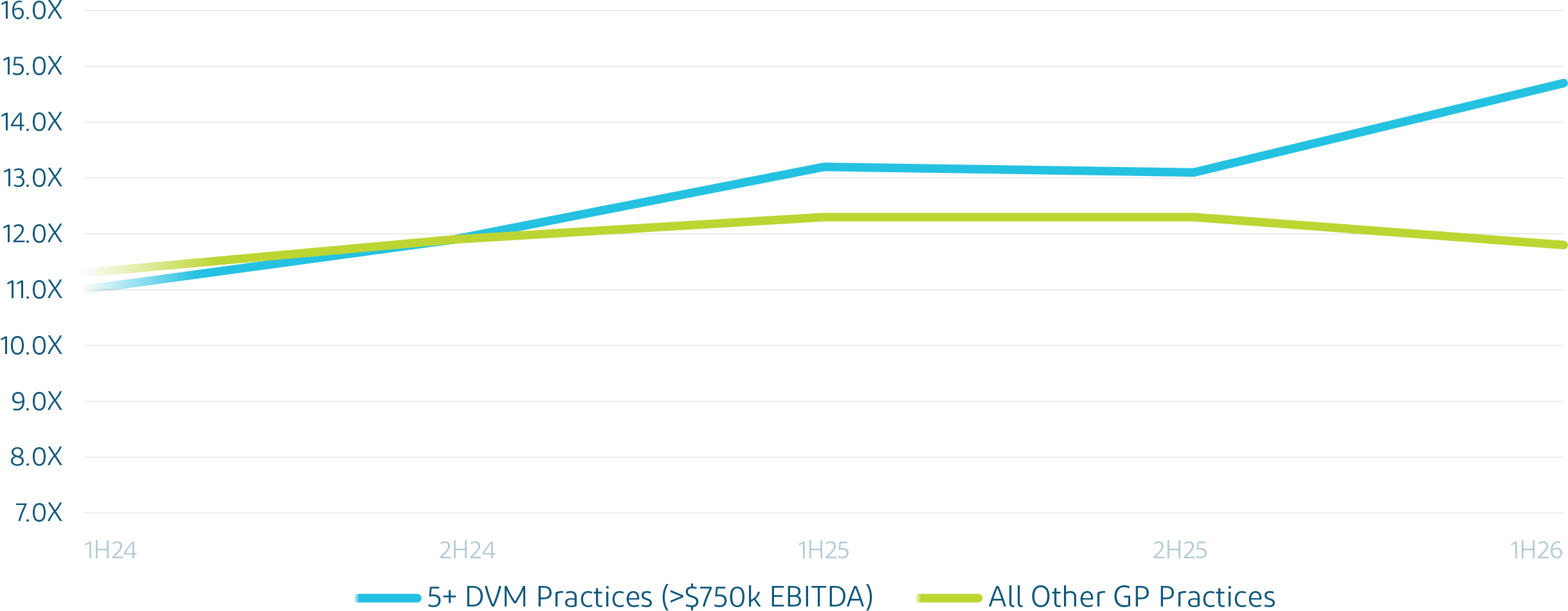
13.4x EBITDA
Weighted Average
(H1 2026)
8x—16x
Range
14.7x
(Large Practices)
11.8x
(Other GP Practices)
20
(H1 2026)
The reason for the divergence
Two factors are driving the divergence in valuation multiples.

Inventory scarcity
Consolidator acquisitions peaked at approximately 1,100 practices in 2021. The following years saw 850 practice sales, then 550, then back-to-back years (2024 and 2025) at roughly 350. There have simply been fewer practices in market. Among large, highly profitable practices specifically, a limited number have come available, and buyers are aware that the total number of independent practices fitting that profile is shrinking. The buyers we talk to are not waiting for the next one. They are bidding aggressively on the ones in front of them because they are not confident of when many more will come available for them to evaluate.

Buyer performance
The question we are watching most closely is whether the CATalyst Council findings change buyer behavior in both segments. Even outperforming buyers have been deploying capital on the assumption that the broader market recovers soon. Some less active buyers have been “waiting out the storm.” If the adoption data changes the recovery timeline assumption, we could rationally see the market change.
Why Now
The valuation gap is being driven by scarcity and performance. Fewer saleable practices are coming to market, and large, highly profitable hospitals are becoming harder for buyers to replace.
At the same time, the best-performing buyers have enough portfolio data to support continued deployment of capital. When those buyers compete for a limited number of high-quality practices, the result is stronger pricing for that segment, even as the broader market remains flat.
General Practice has reversed its historical discount to Specialty and Emergency.
The GP-to-Specialty valuation relationship has inverted over the past 24 months. Through much of the 2010s and early 2020s, Specialty and Emergency hospitals commanded a premium based on their perceived superior revenue growth.
That premium is gone, and in most cases the relationship has flipped.
The active buyer pool for Specialty and ER has contracted sharply. About a half-dozen major pre-COVID acquirers have exited the market, and the smaller cohort that remains is operating in a less competitive environment. For Specialty and ER sellers, that means fewer bidders and less tension in the process. The burden is now on the seller to make a compelling case for the practice’s future upside, something a competitive process used to do automatically.
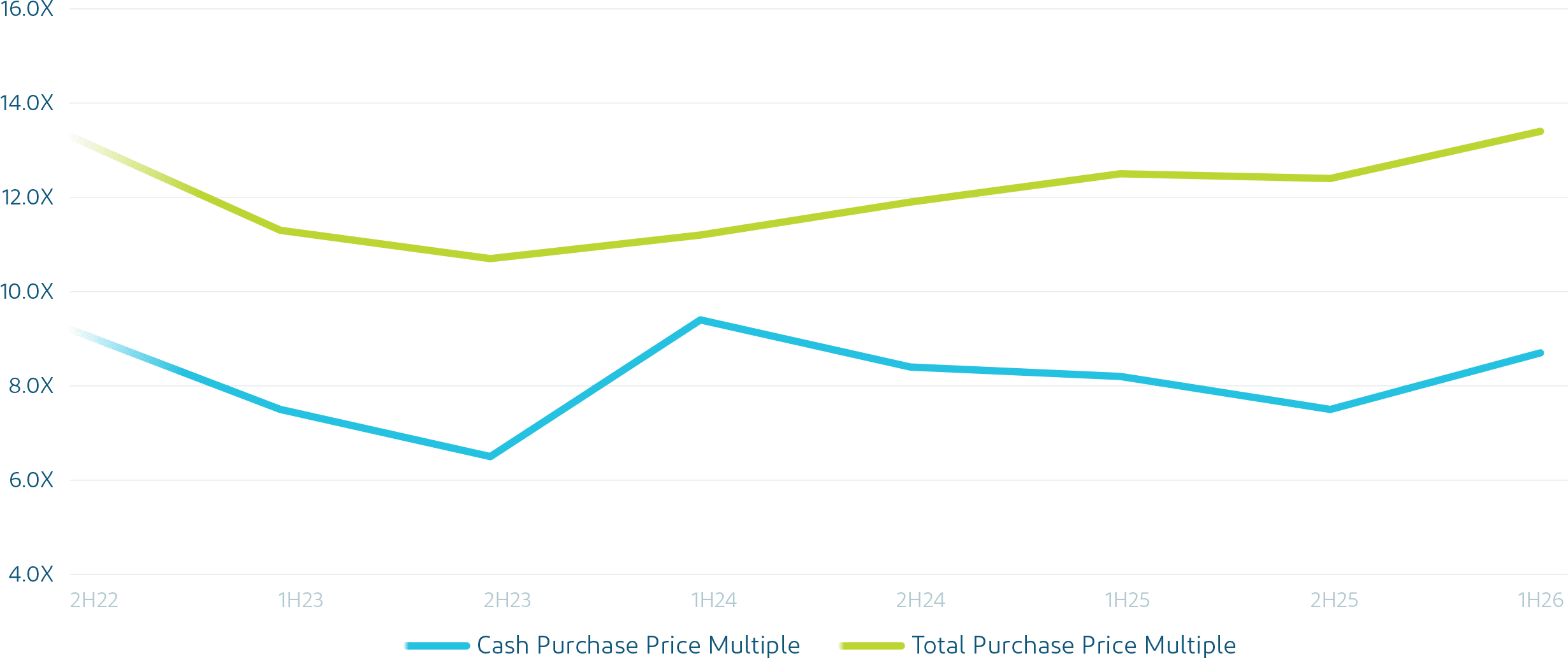
Cash at closing has followed multiples up. For many owners, the real-terms comparison is thought-provoking.
In 2026, GP sellers received an average of 8.7x EBITDA in cash at close, representing 65% of total consideration.
Put simply, this cash-at-close multiple is the number of years of current profit a buyer is willing to pay for a practice today. However, when viewed through the lens of post-tax treatment1, it is actually nearly 11x, or eleven years, worth of profit buyers are paying up front.
The remaining 35% comes as retained ownership in the practice, TopCo equity, and/or seller notes, each of which converts to cash over-time rather than at close. The spread between the two is slightly wider than in prior years; over the past eighteen months, as buyers have sought to manage their own risk, the gap between cash and total consideration has exceeded 4x.
Weighted Average Purchase Multiples:
Total vs. Cash at Close (Half-Year Trend)
[1] The 11x figure reflects an apples-to-apples after-tax comparison. Cash proceeds are taxed at the long-term capital gains rate, approximately 20% for most sellers. Annual distributions are ordinary income taxed at 37% or higher. When both are adjusted for their respective tax treatment, 8.7x at closing is equivalent to roughly eleven years of take-home income.
What should a practice owner take away from this report?
The market is stronger than the headlines suggest for some owners and weaker than the average implies for others. Where you sit in that divide should shape how you think about timing.

Owners 60 and older
Most corporate buyers require three to five years of post-closing employment. An owner in their early 60s who waits two years to engage is an owner in their mid-60s at close, and late 60s/early 70s when their employment agreement should end. Buyers will negatively price that last reality into offers. With current cash-at-closing levels near historical highs, the window is open to realize the equivalent of your EBITDA today all the way into your 70s. That scenario does not persist indefinitely.

Owners under 60, with large (5+ DVM) practices
This cohort has options. Practices with scale, strong margins, and a track record of growth will continue to attract aggressive buyers. If you are confident in your ability to sustain that performance, holding is defensible. The caveat is the demographic variable and its effect on buyers’ future ability to pay today’s multiples. If the CATalyst findings hold, the tailwind this cohort has been counting on is thinner than assumed. That fact may not change the calculus today, but it is worth factoring into your personal outlook.
Owners under 60, with fewer than 5 DVM practices
The question worth sitting with is not exclusively whether to completely sell or hold. The reality is that joint venture deal structures provide you with optionality. Since the CATalyst report was released in early June, this has been the most common strategic question we are working through with owners in this cohort. Initiating a joint venture now shifts some of the performance burden onto a corporate partner while allowing you to pocket nearly a decade’s worth of future EBITDA in cash at close now.
Growth within the veterinary market has become materially more challenging post-COVID and there is now incrementally more uncertainty to when an industry wide recovery happens. Practice owners should be thinking strategically about the best way to compete in this market. We have contended that well run DVM owned practices that have a strong focus on clinical care, client experience and financial performance can outperform many corporate competitors who lack speed of decision making and tend to not customize their approach to the local markets. However, if you own a practice and are too busy juggling family, clinical care and recruiting – a corporate partner may help you succeed in this environment.
Owner Lens
Timing should be personal, not headline-driven.
Owners 60 and older face retirement realities.
Large practices still have leverage if performance holds.
Smaller practices may benefit from outside assistance or a Joint Venture.
Joint Ventures can reduce future risk while preserving upside.
Conclusion
The market for practice sales has an increasing number of moving variables for owners to monitor.
This is a tricky market to navigate, even for the most financially-astute practice owners. While we are not yet at the point of declaring the need to “sell now!”, we are cautious about the number of market forces colliding. Between macroeconomic uncertainty, geopolitical risks, industry headwinds, and now surprising long-term demographic forecasts, there is simply a lot to consider when attempting to predict near-term buyer interest, valuation multiples, etc. Historically, practice owners have considered dialoguing with a broker in advance of a sale process to be unnecessary, yet we can’t help but wonder whether doing so merits reconsideration, simply to remain well-informed during an increasingly turbulent time.
The current valuation multiples are high by any historical measure and the challenges for industry growth over the past 4+ years highlight the
headwinds that practice owners face. The COVID era peak multiples when interest rates were near 0% are not going to return and we are hopeful the
current acquisition environment holds for the rest of the year and into 2027 – but there is uncertainty.
The current environment is not normal by any historical measure. For those holding out hope for a return to pandemic-era multiples, each passing quarter makes the case that those were a “once-in-a-lifetime” occurrence. Owners waiting for a return to those lofty levels are waiting for something that is not coming back.
Questions?
Reach out to your team of advisors:


